0
Ernst Waldow

Total Credits at Criticker: 19 (Actor)
Find more information about Ernst Waldow at The Internet Movie Database
Titles you haven't rated - Actor (19)

In a small German village in the middle of large moors, there is an old legend of a young woman having sunk in the wetland after being raped by a Swedish intruder of the Thirty Years' war. Now young Dorothee, falling in love with the architect Ludwig, is harassed by an obnoxious, rich farmer Eschmann. The brutal man is ready to do anything to get the maiden. The history is repeating itself, as Eschmann follows Dorothee to the moors after his crime. (imdb)
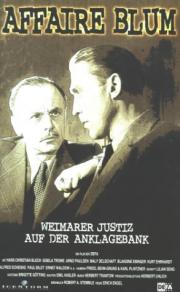
Dr. Blum, a Jewish manufacturer living in Germany, is falsely accused of killing his booker. Even when the real killer's identity becomes evident, the state prosecutor refuses to accept Blum's innocence. The film explores German reaction to the trial and investigates the relationship between the legal system, antisemitism, and fascism, providing insight into the historical context that allowed Nazism to flourish.

Penniless Peter Schild looks for work when arrived in Germany. Working as a private eye he has to observe a young lady who is willing to marry an unemployed actor against the will of her parents.

Peter Korff isn't a famous actor yet, but he is young, handsome, adventurous – and once again hopelessly in love. The object of his affection is named Erika and works as a model at the fashion salon “Yvette.” Although the pretty young woman claims to be just as in love with Peter as he is with her, she's always up for a little fling behind his back.

A group of artists and journalists enjoy a series of romantic entanglements in a country hotel. An author, Vera von Eichberg “of whom no photo exists,” has mentioned the hotel in her work, boosting its notoriety. When another female guest arrives, everyone assumes she is the author, despite her repeated assertions to the contrary.
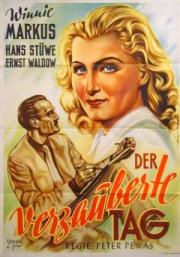
A flower seller at a local station, Christine, whiles away the day with her colleague Anni, both dreaming of finding their true love. Christine encounters and falls for a painter, Albrecht, but is already engaged to the accountant, Krummholz.
Completed in 1944, a year before Brief Encounter, but suppressed by the Nazi authorities until after the war, Der verzauberte Tag stands out as a romantic masterpiece in an era of conformist German cinema.

It can hardly be said that things are peaceful in the Berlin apartment building where the film's story takes place. There are constant clashes between the residents – and sometimes that's quite literal: for example, when the widow Bock hid some explosives among the bricks, which detonated when the building's thieving doorman lit them in his stove.

The printing worker Lena suffers a lot from the teasing of her colleagues, because no one really knows who the child she expects is from. The alleged father, sailor Ole Thomsen, is on his way. When he comes back, doubts also prevail over him, and he sits down. When Lena wants to take her own life, the doubters come to their senses and found a fund for the boy to be expected.

Peter asks Baron Vermehren, a renowned astrologer, for the hand of his daughter Julia. The baron claims that the stars allow the match only after Peter steals a large sum of money. Honest Peter desperately sets out to commit the crime.

He who loves, torments himself: This turn of phrase works for the big farmer Gerd Tapken and his landlady Katrin Geerken. For more than 30 years, the two have fought at every opportunity, although they secretly love one another. But things seem to have come to a serious breach when Tapken shoots Katrin's cat, because it allegedly ate three of his hens. The woman is so enraged over this brutality, that she contacts her lawyer.

A diligent office worker and a cheeky sales representative are tasked by their boss with reserving a first-class hotel room with a bathroom for a visiting Hamburg exporter and his wife. A misunderstanding leads to non-stop confusion, because the office worker is spending his first wedding anniversary with his wife in the rented hotel room.

Undergraduate Nik just wanted to get cigarettes when he is pulled into a series of events over the course of one night. Also during this night he meets three interesting women - whom will he end up with?

Pierre Pasqual has just about everything his heart desires: in his career as a commercial pilot, he is well known and successful; he has wealth and a beautiful wife. The only thing is, that because of his career, Pierre is frequently away and the thought constantly tortures him, that his wife is up to something when he's not home. “Who's kissing Madeleine?” is the question Pierre must have answered.

In this love triangle, two comrades working at a Berlin auto repair place fall out over a waitress they both want.The only way Rudi can think of winning away Erika from Hanni is to badmouth her to his rival.
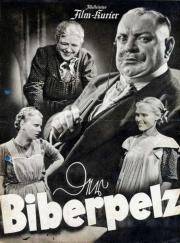
In a district of a small, German principality, things are going haywire. And this, even though Baron von Wehrhahn, who is loyal to the prince, does everything possible to make "his Highness" popular. The only problem is, he's always using his zeal on the wrong crowd. He always seems to see free-thinkers or revolutionaries in the harmless of citizens; but the really bad ones get to go on their way unmolested!

Pension Elise Nottebohm (1937) - Short Film
An unknown curiosity even for experts, this is a film from the late work of the director of the classic films Mother Krause's Journey to Happiness (1929) and Berlin, Alexanderplatz (1931). Although the communist Philipp Jutzi readily switched sides to the new rulers of Germany after the change of regime, the Goebbels administration did not forget his past.

Curt serenades his wife Charlott from the garden without her recognizing him. When she later doesn't refer to the incident he assumes that she is falling for the ‘unknown' suitor and deliberately puts a notorious womanizer on her trail.

The heir to a soap factory gets a job incognito in a branch of his family's company and uncovers sleazy deals going on, as he courts a young woman.

In this film, the people of a Tyrolean town climb up into the nearby mountains, searching for a place where they can hold a picnic and a spring festival: ideally, a place where they can eventually erect dwellings and cultivate crops. Led by the local nobleman (Arthur Ehrens), they find an appropriate spot, and the festivities begin. Some children briefly perform a charming folk dance. Suddenly the Rübezahl arrives and threatens to kill all the townsfolk if they don't leave immediately.
Streaming data provided by 