22
Hsiao-Hsien Hou

Date of Birth: 08 Apr 1947
Country: Taiwan
Biography: Hou Hsiao-hsien (born 8 April 1947) is a Mainland Chinese-born Taiwanese film director, screenwriter, producer and actor.
Total Credits at Criticker: 6 (Actor), 19 (Director), 8 (Writer)
Biography submitted by Rivette
Find more information about Hsiao-Hsien Hou at The Internet Movie Database
Titles you haven't rated - Actor (6) | Director (19) | Writer (8)

The film is set during the mighty Tang Dynasty-period in Chinese history. Nie Yinniang returns to family after several years in exile. The mission of her order is to eliminate the tyrany of the Governors who avoid the authority of the Emperor. Now she will have to choose between sacrificing the man she loves, or break definitively with the "order of the Assassins" (Martin Matevosyan)

Suzanne (Juliette Binoche) is charming but she is a mother snowed under by obligations. With her puppet shows, the classes she teaches and the two children, Simon and Louise, that she has been raising alone since their father left, she hasn't got a minute to herself. To help her, she takes in a young Taiwanese babysitter, Song Fang, who is a student at Paris University... (imdb)

Set across three different eras in Taiwan—1966, 1911, and 2005—the film follows the evolving romantic connection between a man and a woman in three distinct stories. From a pool hall in the 1960s to a 1910s courtesan house and modern Taipei, their encounters explore themes of love, longing, and freedom across changing social landscapes.

A residential neighborhood in Tokyo, 2003. Yoko, a freelance writer researching musical legend Jiang Ewn-Ye, befriends Hajime, the owner of a secondhand bookstore. They spend many hours together in the district's coffee shops and train stations. Yoko feels she can tell the quiet, calm Hajime anything. When she is with him, she experiences an unusual peace of mind, a calmness of spirit. For his part, Hajime loves Yoko profoundly, but remains silent... (Wild Bunch)

The remarkable Shu Qi stars as Vicky, a lost soul who hangs out partying with her friends, smoking nonstop, and dancing and flirting. She lives with Hao-Hao (Tuan Chun-hao), but he doesn't seem to excite her anymore, so she starts seeing an older gangster, Jack (Jack Kao), although the depth of the relationship is left purposely ambiguous. Although Vicky wants to be a free spirit, she is battling demons that cast dark shadows over her somewhat meaningless existence. (Rotten Tomatoes)

In late 19th-century Shanghai, the elegant "flower houses" serve as exclusive enclaves where wealthy patrons and courtesans navigate intricate social rituals. Master Wang forms a complex bond with Crimson, a veteran courtesan struggling to maintain her status amid shifting affections and debts. Through silent negotiations and subtle gestures, the closed world reveals fragile balance between power and affection.

This Film explores the world of small-time crime in the present-day suburban backwaters of Taipei.It follows the luckless entrepreneurial ventures of Kao (Jack Kao) and his misfit cohort Flat Head (Lim Giong). A non-stop schemer, Kao devises a plan to raise money by trading subsidized pigs to the government for cash. The ruse works, but when the temperamental Flat Head antagonizes the wrong people, the two find themselves caught up in a dangerous game of corrupt politics.(tigercinema.com)

Intended as the concluding film in the trilogy on the modern history of Taiwan began with Beiqing Chengshi (1989)... (imdb)

In Japanese-occupied Taiwan, puppet master Li Tian-lu grows up learning the traditional art of glove puppetry amid severe political upheaval. As World War II forces cultural suppression and the prohibition of native theater, Li must navigate forced compromises with Japanese propaganda troupes. His personal life unfolds against decades of loss, resilience, and shifting national identity.

Set during the turbulent transition after the end of Japanese colonial rule, the narrative follows the experiences of the Lin family in Taiwan. As the brothers navigate personal tragedies and political upheaval, including the 228 Incident, the film explores the intersection of private lives and national history. It is a profound meditation on memory, loss, and the struggle for identity.

This is a compelling Taiwanese drama about a wistful schoolgirl (Yang Lin) who is peripherally involved in a teen-aged crime ring. She escapes from the harshness of her surrounding reality by reading her favorite comic book, Daughter of the Nile. Despite its inherent whimsical nature, the film is a straight-on look at urban decay in modern Taiwan.

A young couple from a small mining town moves to the bustling city of Taipei to seek better opportunities and support their families. As they struggle with low-paying jobs and the harsh realities of urban life, their relationship is tested by physical distance and the relentless pressures of adulthood, leading to a bittersweet meditation on love and endurance.

This evocative coming-of-age drama follows a young boy named Ah-ha as he grows up in rural Taiwan. The narrative captures the quiet rhythms of daily life and the inevitable passage of time, focusing on the protagonist's evolving relationships with his family members against a backdrop of personal loss and the shifting social landscape of the post-war era.

A young boy and his sister are sent to spend their summer vacation at their grandfather's rural home in the countryside. While their mother recovers from an illness, the children navigate the nuances of village life, witness the complexities of the adult world, and experience a poignant transition from childhood innocence to a deeper understanding of reality.

After finishing school, Ah-Ching and his friends spend their idle days getting into fights and wandering around their small island village. Seeking better prospects, they move to the industrial port city of Kaohsiung. As they face the realities of working-class adult life, unexpected responsibilities, and emotional complications, their youth and close-knit bonds are put to the test.

Composed of three separate stories. The first tells about a man who ekes out a living for his young family by carrying advertisement sandwich boards. The second vignette tells of two ambitious young men who discover too late that a product they are trying to sell is defective. The third vignette explores what happens when a poor laborer is struck by a high-ranking American official's automobile.

Da-Nian is a young man from Taipei. He goes to a remote village and works as a substitute teacher. He and Su-Yun, another teacher at the school, fall in love. There are several students in his class who are like the naughty "three musketeers", and a sad, silent boy Xiang-Wang, whose parents are divorced. Besides, in order to support the family, Xian-Wang's father kills the fish in the river with electricity, which is against the law and causes a lot of damage to the natural resources. (imdb)
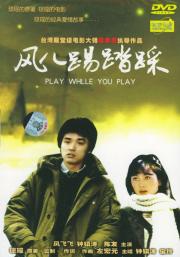
Play while You Play, usually known as Cheerful Wind (1981), is Hou Hsiao-hsien's second film, a romantic drama about a blind man and a somewhat self-indulgent television producer. It's one of his three commercial "musicals," and seldom seen, let alone discussed. I think that stylistically these films lay the groundwork for his Taiwanese New Wave films from The Sandwich Man onward. (surrealmoviez)

Hou's first movie is a romantic comedy about a couple which is in love for each other.
Streaming data provided by 