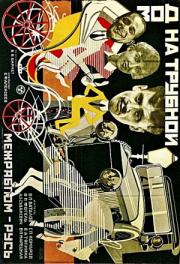

Dom na Trubnoy

This is something of a Bolshevik fairy tale. Released in the era of the New Economic Policy (and featuring a prominent portrait of the NEP’s mahatma, Nikolai Bukharin), this is not the Soviet Union of your Baby Boomers and Generation X-ers. There are no secret police at work and I don’t think there’s a single reference to the Communist Party at all. Instead, we have an ensemble story that celebrates collective expression against individualism, and the struggle to ensure worker’s rights against exploitation.
Many have noted that it is a variation on Cinderella, and there’s no reason to quibble with that. Director Boris Barnet seems more interested in evoking a mood than to tell a story. Cause and effect are not always clear, but somehow that doesn’t detract from the charm. The ending is abrupt, but also it is rare example of a film knowing with precision where to make an end. What happens to our protagonist, ‘Parasha’ Pitunova (Vera Maretskaya), when her night at the ball ends with the carriage turned into a pumpkin, is irrelevant. Her own transformation has been completed without the need of a Prince Charming, but with a Fairy Godmother.
As the title suggests, the main character is the house on Trubnaya, not Parasha. Even though there are individuals in the film, the real characters are collectives. The residents of the house are a collective created out of space, in that they all live in the same building. There are moments when we see the house as a cross section, with the residents interacting on the stairs. This is quite effective at illustrating the kind of place it is. It also reveals that humanity is a mixed lot of good and bad, and without a collective consciousness not particularly effective at achieving much.
Lurking in the house are the villains of the piece, the barber Mr Golikov (Vladimir Fogel) and his wife (Yelena Tyapinka). These Small Business Tyrants want to create a job for a maid, but not at union rates. Pitunova is forced to take the job by circumstance, and accept below-par pay because she is not familiar with the union. Now, as the Cinderella of the story, we track her acquisition of class consciousness. The collective setting through which she learns how to be part of something greater are the heart of the film.
The ghastly Mrs Thatcher desired to reinvent the British people, to unleash those of them with an entrepreneurial, buccaneering spirit. Likewise, the Soviet Union sought to create ‘socialist people’, motivated to defend the collective interest against individualists who threatened the new order. It all sounds terribly worthy, but it really isn’t. My only real complaint is that some of the montage gets a bit repetitive. Otherwise, the film is rather fun, and has a few surprises in it, most notably a freeze-frame in the classic ‘well, how did we get here?’ mode.
© 2026 Paul Brewer
Mini Review: It's a lovely tale of a Cinderella in the Big City under socialist conditions. Well worth a look.
Watch the Trailer