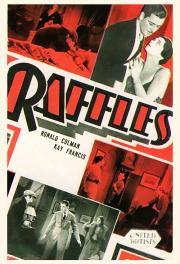
Raffles

The name ‘Raffles’ started circulating in my head long ago, though probably not before the 1970s. However, its associations to me were very ambiguous. Was it a person? A place? An hotel? All of these? By the time I had been translated to London, in the 1980s, a degree of clarity had ensued. There were persons (or possibly one person) named Raffles, who was associated with Singapore and gentlemanly behaviour, although there was some kind of illegality that one perhaps didn’t talk about. He was either a fictional character or a real person, or possibly both at the same time. But before I could refine these conceptions to achieve real understanding, history and education ended while life and experience began.
Only in Anno Domini 2026 did things finally become clear, on a night when I watched Ronald Colman playing the part of the Amateur Cracksman, A. J. Raffles (with no apparent connection to Sir Stamford Raffles, the founder of Singapore), in a film produced by Samuel Goldwyn and credited to George Fitzmaurice. I’m sure twenty-first century audiences might find this film a bit quaint, with its black-and-white photography, sound-stage settings and ancient moral standards. However, don’t let your prejudices redirect you. This is greatly entertaining and over before you’ve had time to finish a jumbo serving of popcorn with a 20 oz drink.
Raffles is a character drawn from turn-of-the-last-century literature, a magazine contemporary to Sherlock Holmes. I‘ve never cared much for Holmes. The cricket-playing, debonair thief Raffles is a much more attractive character, to me, and I’ll be sure to read some of E. W. Hornung’s work in the near future. (I should note that the literary Raffles is apparently a good deal less debonair than the cinematic version.) In the 1930 film, he is portrayed by Ronald Colman, who probably ought to have defined the role for all time. In the stories, his partner in crime is his fag [NB – I am using this word in its English sense, not the American slur] from school-days, Bunny (here played by Bramwell Feltcher). Bunny is very much a minor character in the film, but his plight does provide the MacGuffin for the story. Raffles also unexpectedly has to rely on help from Gwen (Kay Francis), a member of the Smart Set with whom Raffles falls in love. (Is it me, or is her main role here to clarify Raffles’ sexuality?) Francis is the only character whose accent lets down the British setting, something on which the remainder of the cast is too courteous to pass comment. (I’ve admitted before that Francis’ charms are lost on me, and in that regard this film does her no favours, but she is excellent at the individual reaction shot common in this era.)
The film moves through its story with great economy, as Raffles becomes the target of McKenzie of Scotland Yard (David Torrence) during a country-house party where the thief has set his sights on a necklace belonging to the wife (Alison Skipworth) of his host (Frederick Kerr). The whole effort retains its ability to hold one in suspense and the abrupt ending seems to promise a sequel in due course. (We did get one, but not with Colman.) It seems a shame that Raffles has receded into obscurity, while Holmes gets regularly reinvented and reimagined for a new audience, though. Someone should take this up for a streaming service.
© 2026 Paul Brewer
Only in Anno Domini 2026 did things finally become clear, on a night when I watched Ronald Colman playing the part of the Amateur Cracksman, A. J. Raffles (with no apparent connection to Sir Stamford Raffles, the founder of Singapore), in a film produced by Samuel Goldwyn and credited to George Fitzmaurice. I’m sure twenty-first century audiences might find this film a bit quaint, with its black-and-white photography, sound-stage settings and ancient moral standards. However, don’t let your prejudices redirect you. This is greatly entertaining and over before you’ve had time to finish a jumbo serving of popcorn with a 20 oz drink.
Raffles is a character drawn from turn-of-the-last-century literature, a magazine contemporary to Sherlock Holmes. I‘ve never cared much for Holmes. The cricket-playing, debonair thief Raffles is a much more attractive character, to me, and I’ll be sure to read some of E. W. Hornung’s work in the near future. (I should note that the literary Raffles is apparently a good deal less debonair than the cinematic version.) In the 1930 film, he is portrayed by Ronald Colman, who probably ought to have defined the role for all time. In the stories, his partner in crime is his fag [NB – I am using this word in its English sense, not the American slur] from school-days, Bunny (here played by Bramwell Feltcher). Bunny is very much a minor character in the film, but his plight does provide the MacGuffin for the story. Raffles also unexpectedly has to rely on help from Gwen (Kay Francis), a member of the Smart Set with whom Raffles falls in love. (Is it me, or is her main role here to clarify Raffles’ sexuality?) Francis is the only character whose accent lets down the British setting, something on which the remainder of the cast is too courteous to pass comment. (I’ve admitted before that Francis’ charms are lost on me, and in that regard this film does her no favours, but she is excellent at the individual reaction shot common in this era.)
The film moves through its story with great economy, as Raffles becomes the target of McKenzie of Scotland Yard (David Torrence) during a country-house party where the thief has set his sights on a necklace belonging to the wife (Alison Skipworth) of his host (Frederick Kerr). The whole effort retains its ability to hold one in suspense and the abrupt ending seems to promise a sequel in due course. (We did get one, but not with Colman.) It seems a shame that Raffles has receded into obscurity, while Holmes gets regularly reinvented and reimagined for a new audience, though. Someone should take this up for a streaming service.
© 2026 Paul Brewer
Mini Review: The film moves through its story with great economy, and holds one in suspense throughout. The abrupt ending seems to promise a sequel in due course. (We did get one, but not with Colman.) It seems a shame that Raffles has receded into obscurity in the twenty-first century.