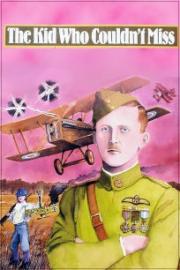
The Kid Who Couldn't Miss

Among my bookpiles is an unusual volume entitled Hanging a Hero: The National Film Board's Shameful Attempt to Discredit Billy Bishop, VC, a nearly 400-page collection of newspaper clippings, book excerpts, senate testimony, personal correspondence, and much impassioned invective courtesy of H. Clifford Chadderton, its author and longtime War Amps head. The film in question is 1983's The Kid Who Couldn't Miss, which Chadderton argues, as hinted at in the title, is a poorly sourced, deliberately misleading attempt to disparage one of Canada's most decorated servicemen, marketed as a documentary. Having seen the film, I can say that, whatever the realities of Bishop's record or the film's other virtues, Chadderton's characterization is fair and essentially correct.
Director Paul Cowan's first film over an hour, the Commonwealth Games doc Going the Distance, netted him an Oscar nomination. The strategy for his second was a little more, you might say, ambitious. The following storytelling methods are used:
- Real interviews with those who served with Bishop
- Extensive excerpts from a filmed production of John MacLachlan Gray's musical comedy Billy Bishop Goes to War, with Bishop played by Eric Peterson
- Completely scripted, newly filmed interviews with Peterson also playing a fictionalized version of Walter Bourne, Bishop's British colleague and mechanic
- Stock footage from a multitude of sources, used for a multitude of purposes
The film moves freely among these, with little indication. We are intended to recognize immediately, for example, that Eric Peterson is playing both the moustachioed Canadian Bishop in the pre-existing footage as well as the barefaced British Bourne in the new scripted stuff, and that Peterson is not 80 years old so of course it's not a real interview. This is easy enough. But no mention is made of the origins of the scripted material, whether it was based on real statements or opinions of Bourne's or simply made out of whole cloth. This eventually presents some real problems, when Peterson-as-Bourne implies that the condition of Billy Bishop's plane after his famous Victoria-Cross-winning raid was inconsistent with Bishop's later statements, and consistent with Bishop landing in a field, shooting up his own plane with his own gun (which all sides acknowledge was missing), then taking off again alone for base to regale his comrades and bosses with tales of a daring raid that never happened.
The film spends no time whatever on the particulars of this scenario. In rebuttal, Chadderton quotes the director of Canada's National Aviation Museum in establishing that the landing/take-off logistics of the plane Bishop was flying would have made such a stunt physically impossible; it would have required multiple co-conspirators, all employing remarkable ingenuity in somehow simulating an entirely different angle of fire with the disengaged Lewis gun. Cowan's film also contends that, even though it is agreed there was no structural damage to Bishop's plane, that the amount of damage supposedly inflicted on the plane's canvas during the raid would have precluded Bishop's flying the plane again later that day; Chadderton also demonstrates this to be untrue. The film's narration, written by Cowan, flatly states that claims that the canvas of Bishop's plane was "in tatters" are "not so". This is immediately followed by Peterson-as-Bourne, who lends support to Cowan's statement with fictional witness testimony scripted by Cowan himself! No actual elaboration for the "not so" statement is provided, but according to Cowan's later senate testimony on the matter, the single solitary source was the decades-later memory of a fellow pilot who declined to go on the raid with Bishop right before it happened.
There is also this: the real Walter Bourne considered himself a friend of Bishop's, never uttered a public word against him or his claims, and warmly corresponded with him later in life. The film's mischaracterization of Bourne and his views is not limited to a scene or two; not only does Peterson return again and again as Bourne to recite Cowan's script—alternating, remember, with his appearances as Bishop in the filmed play footage—he also appears as Bourne in doctored old-timey portraits of the mechanic as a young man, and is introduced soberly by Cowan: "as Bishop's mechanic, Bourne will later play his part in the Billy Bishop legend".
Again, it seems absurd to argue, as the film's harshest critics did, that Cowan intended the audience to believe the obviously non-archival footage with the thirtysomething Peterson represented an actual interview with a man who served in the first World War, but it is equally absurd to argue Cowan was uncomfortable with the possibility that less sophisticated viewers might be so swayed, or that the utter lack of clarity w/r/t exactly whose words Peterson was uttering might convince even the most sophisticated ones that said words were something more than what they were, i.e. cobbled together from decades-later reminiscences from a different man altogether who for obvious reasons is unsuitable as a primary source.
The most charitable interpretation of these Bourne sections is as some kind of reflexive conceit about the way heroes are made and unmade, a de-mythologizing of Bishop bearing as little resemblance to fact as Cowan's conception of the mythologizing, per the director's stated intention to "examine philosophically what it means to be a hero in this country". But such an approach is at odds with the simultaneous aim of holding the Bishop legend accountable to the historical record. I don't suppose it is inherently so, but certainly as presented here, aggravated by Cowan's poor showing in the "real" interviews—the moment he asks "was Bishop a fraud?" to one of the men in his squadron has the faint air of that moon-hoax jackass Buzz Aldrin socked. A stronger stench is emitted by the half-assed associative collage that constitutes the film's extensive use of stock footage, with a spooooooky musical score, ironic song choices, and editorializing narration commenting on an endless cycle of Hollywood flight films, a Russian World War II (!) feature, play excerpts, newsreels, and aerial dogfights that are presented as depictions of Billy Bishop in action against none other than the Red Baron himself, Manfred von Richthofen. Here again we are expected to rely on our media literacy to deduce this is not actual footage of Bishop and the Baron, and here again the actual content is invented: narrator William Hutt relays a wild and emotional tale of Bishop, Richthofen and the latter's brother Lothar that would appear to be apocryphal. Additionally, Cowan consulted amateur aviation enthusiasts who unsuccessfully lent their support in the senate investigation, and whose easily disproved suppositions regarding fuel burn rates, flight patterns, and the like evoke yet another wacko, namely self-taught execution "expert" Fred Leuchter and his phony technical analysis at Auschwitz, documented in the great Mr. Death by Errol Morris, who was sadly not yet around for filmmakers like Cowan to rip off. There is almost nothing in the film that could qualify as a "philosophical examination" of anything, and not even enough content to qualify it as essay film. At best, it's a misguided curio whose amateurish conceits offer some passing interest, but not nearly enough to offset the arrogance and laziness of the whole venture.
The senate eventually concluded that the film's distortions were such that it could no longer be marketed as a documentary, but must be reclassified as a docudrama, and with a new disclaimer inserted at the beginning. The final version is milder than that recommended by the politicians (and the recall and total destruction recommended by Chadderton) but alerts viewers that the film "combines elements of both reality and fiction. It does not pretend to be a biography of Billy Bishop. Certain characters have been used to express certain doubts and reservations about Bishop's exploits. There is no evidence that these were shared by the actual characters." (There are many other less glaring misrepresentations in the film, like the compression of Bishop's tour, transparent in their service of Cowan's thesis.)
To be sure, there are questions about Bishop's record that have not and likely will never be answered, and the details of the confirmation of his Victoria Cross, a rare awarding without eyewitness corroboration, is sealed. This could make a worthwhile film. But perhaps the best indicator that the filmmakers in question were not those for the job can be found what is initially the most unassuming of Chadderton's appendices, a series of letters exchanged with a woman by the name of Katie Malloch. She'd written a letter to the War Amps, ostensibly as a private citizen expressing her disapproval of Chadderton's campaign against the film and Cowan ("part of what was amputated must have been your brains"). Chadderton replied, and they embarked on an adversarial if polite correspondence, Chadderton laying out his arguments and Malloch relying on the doubts about Bishop's record as justification for Cowan's methods, consistently stating no connection to him or the film, and making repeated mention of house renovations undertaken with an unnamed husband. After a number of letters, Chadderton announced he was terminating the correspondence. Turned out he'd been suspicious about a very specific research reference she'd made, prompting him to look up Paul Cowan in the Montreal phone book. The address was the same as that on Malloch's letters. (He needn't have done even that. Her name is right there in the film's end credits as a researcher.)
Cowan got over this little speedbump and went on to make many more films for the Board. His next was Anybody's Son Will Do, about the dehumanizing effects of U.S. military training. Malloch went on to a long career as a broadcaster with the Canadian Broadcasting Corporation. She retired in 2012.
They remain married.
Mini Review: Among my bookpiles is an unusual volume entitled HANGING A HERO: THE NATIONAL FILM BOARD'S SHAMEFUL ATTEMPT TO DISCREDIT BILLY BISHOP, VC, a nearly 400-page collection of newspaper clippings, book excerpts, senate testimony, personal correspondence, and much impassioned invective courtesy of H. Clifford Chadderton, its author and longtime War Amps head. The film, Chadderton argues, is a poorly sourced, deliberately misleading attempt to disparage one of Canada's most decorated servicemen...